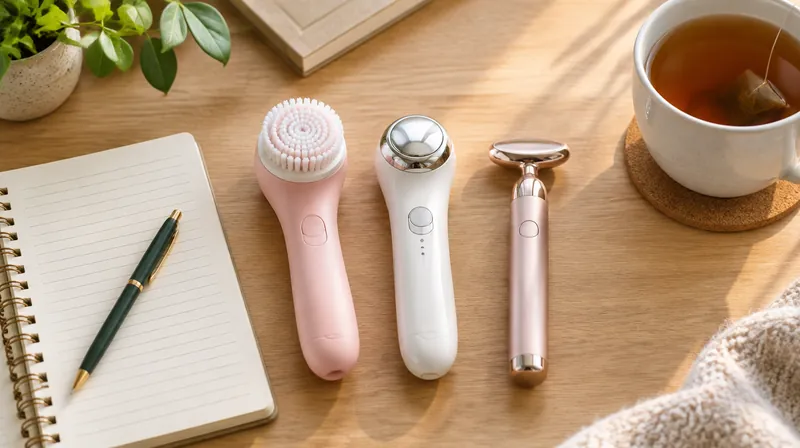
What Is At-Home Ultrasound Skincare? How It Works, Benefits and Safety
Multi-frequency ultrasound has jumped from Korean clinics to bathroom counters. Here’s what the MHz numbers mean, what these devices are designed to do, what the evidence supports, and how they differ from Ultherapy and HIFU.
Our publisher, Dalmie LLC, sells Quadthera. We don't earn commissions from other links in this article. Disclosure.
The short answer
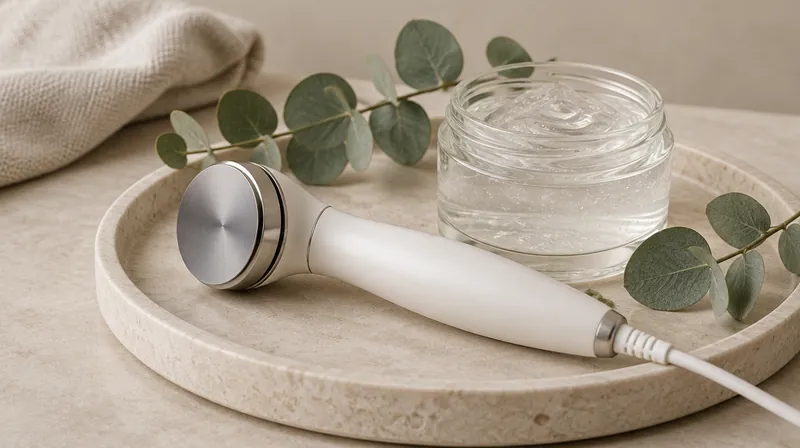
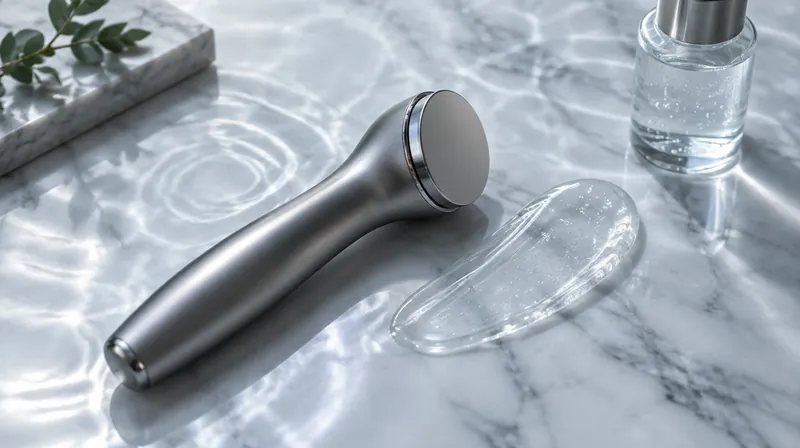
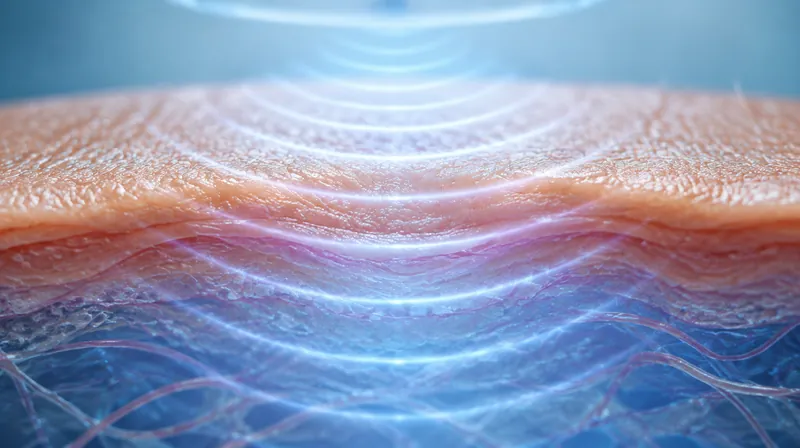
At-home ultrasound skincare devices are handsets that send low-intensity, non-focused sound waves into the skin through a layer of gel or serum. They usually alternate between several megahertz frequencies. Brands market them for hydration, smoother texture, a calmer look, better absorption of skincare and, over time, a firmer look. The best-supported mechanism is that ultrasound can make skin more permeable to topical products. Evidence that specific home devices produce visible anti-aging results is still limited and mostly paid for by the brands. And they are not at-home Ultherapy. Clinical focused ultrasound is a different, more powerful and more regulated technology.
Ultrasound basics: what MHz means
Ultrasound is sound above the range of human hearing, above about 20 kHz. Device frequencies are given in megahertz (MHz), millions of cycles per second. Medical imaging uses roughly 1 to 20 MHz.
The key rule: the higher the frequency, the faster the energy is absorbed and scattered in tissue, so the shallower it acts. Lower frequencies travel deeper. That’s why imaging probes for deep organs use low frequencies and probes for superficial structures use high ones (StatPearls, Ultrasound Physics and Instrumentation).
Home devices apply the same logic to skin. A device that offers 1, 3, 10 and 19 MHz is trying to cover several depths, with 19 MHz acting nearest the surface and 1 MHz the deepest. A dual-frequency device such as 3 + 10 MHz covers fewer. What the numbers don’t tell you is output power or dose, which brands rarely publish in comparable units. Nor do they prove that one frequency combination gives better visible results than another. No head-to-head consumer study we know of has shown that.
Three very different “ultrasound” beauty tools
| Type | Frequency | Energy | Used for | US regulation |
|---|---|---|---|---|
| At-home multi-frequency ultrasound (“LDM-style”) | Megahertz range, e.g. 1–19 MHz | Non-focused, low intensity | Daily cosmetic care: hydration, texture, product absorption, look of firmness | Typically Class I listed (e.g. code ISA); not cleared |
| Ultrasonic skin scrubber / spatula | Kilohertz range | Non-focused vibration at a metal blade | Exfoliation and pore cleansing | Varies |
| Clinical HIFU / microfocused ultrasound (e.g. Ultherapy) | Megahertz, focused | Focused to heat small points deep in tissue | In-office lifting of brow, neck and under-chin; décolleté lines | Class II (21 CFR 878.4590); Ultherapy authorized via De Novo in 2009 |
This article is about the first type. If a product page uses “ultrasound,” “ultrasonic,” “LDM” and “HIFU” interchangeably, slow down and check which one you’re looking at.
What at-home devices are designed to do
1. Help skincare absorb (sonophoresis)
Applying ultrasound to skin can temporarily increase its permeability, a process called sonophoresis. It has been studied for decades as a way to deliver drugs through the skin (Azagury et al., 2014; Park et al., 2014). One caveat: the strongest permeability effects in that research come from low-frequency ultrasound below 100 kHz (Mitragotri & Kost, 2004). Most of it is pharmaceutical research, not tests of consumer beauty devices. So the absorption claim has a plausible scientific basis, but the size of the effect for a given home device is usually unknown.
2. Gentle mechanical “micro-massage”
The oscillating head creates tiny vibrations in the skin. Brands link this to a hydrated, plumper, calmer look. That’s a reasonable description of the experience, but it’s hard to measure independently.
3. A firmer look over time
Some brands say their devices support collagen or firmness. This is the claim with the least independent support for non-focused home devices. When a brand cites a study, check who ran it, how many people took part and whether there was a control group.
What the research does and doesn’t show
Disclosure: GlowLab's publisher, Dalmie LLC, is a US retailer of Quadthera and may earn from sales. Learn more.- Reasonably established: ultrasound can increase skin permeability (sonophoresis). Higher frequencies act more superficially.
- Plausible but under-tested: that a given home device improves absorption of everyday skincare by a meaningful amount.
- Mostly brand-supported: visible improvements in firmness, pores and texture. Several brands cite their own studies, for example THOME on its product pages and Quadthera’s 4-week, 20-person evaluation by a Seoul research center. These are useful signals, but they are small and sponsored, and full reports are often not public.
- Not shown: that home devices match clinical HIFU or Ultherapy. They aren’t designed to.
For context, LED light therapy has more published trials, including randomized, sham-controlled studies of home masks. See our technology comparison.
At-home ultrasound vs HIFU and Ultherapy
Ultherapy is the best-known clinical ultrasound treatment. FDA first authorized it in 2009 through the De Novo pathway (DEN080006). Its regulatory category, “focused ultrasound stimulator system for aesthetic use,” is Class II with special controls (21 CFR 878.4590). It focuses energy to create small heated points deep in the tissue. A 2022 expert consensus describes it as FDA-cleared to lift the soft tissue of the neck, under the chin and the brow, and to improve lines on the upper chest (Pavicic et al., 2022).
Focused ultrasound is powerful enough to cause harm when misused. Reported side effects are usually mild and short-lived (redness, swelling, bruising), but rare serious events such as blistering, ulceration and tissue atrophy have been documented (Friedmann et al., 2018).
Home devices use non-focused, low-intensity energy. That makes them very different, and much gentler. It also means you shouldn’t expect HIFU-style lifting. Be wary of consumer gadgets that claim to be “HIFU”: by definition they are trying to do something riskier.
How these devices are regulated
In FDA’s database, several popular home ultrasound devices, including models from Quadthera (our publisher, Dalmie LLC, retails Quadthera), THOME and glow.m, are listed under product code ISA, “massager, therapeutic, electric.” That’s a Class I category exempt from premarket notification (21 CFR 890.5660). Being in the database means the manufacturer registered and listed the device. It does not mean FDA reviewed or cleared it. FDA’s rules say registration “does not in any way denote approval,” and implying otherwise is misbranding (21 CFR 807.39).
So treat “FDA registered” on a beauty device as a neutral fact, not an endorsement. “FDA-cleared” refers to a 510(k) or similar decision, which you can look up by its K-number.
Safety and who should check first
Non-focused home ultrasound is generally marketed as gentle, and these devices don’t rely on light or deliberate heating. Sensible precautions still apply:
- Read your device’s manual. It’s the authority on contraindications for that model.
- Keep off the eyelids and eyes. Several brands say under-eye use is fine but eyelids are not.
- Avoid broken, infected or actively inflamed skin.
- Check with a clinician first if you are pregnant, have an implanted electronic or metal device, a thyroid condition, a skin disorder or recent cosmetic procedures, or take medication that affects your skin.
- Always use enough gel. Stop if you feel heat, stinging or pain.
How to use one well
- Cleanse and dry your face.
- Apply a generous water-based layer: conductive gel, or the serum or ampoule your device recommends. Avoid heavy oils unless the manual allows them.
- Pick a mode and a low intensity for the first sessions.
- Glide slowly, keeping the head flat and in contact. Re-apply gel if it drags.
- Let the timer run (often about 10–12 minutes), then finish with your normal skincare and sunscreen in the morning.
- Be consistent, and judge results over several weeks, not days. Take photos in the same light.
Ready to compare devices? See the best at-home ultrasound facial devices.
Disclosure: GlowLab's publisher, Dalmie LLC, is a US retailer of Quadthera and may earn from sales. Learn more.That guide includes Quadthera devices alongside other brands.
Frequently asked questions
Does at-home ultrasound really work?
What does LDM mean?
Is at-home ultrasound the same as at-home HIFU?
Can I use it with retinol, vitamin C or acids?
How often should I use an at-home ultrasound device?
Will it make my face lose fat?
Sources
- StatPearls: Ultrasound Physics and Instrumentation (NCBI Bookshelf)
- Azagury A, et al. Ultrasound mediated transdermal drug delivery. Adv Drug Deliv Rev. 2014
- Park D, et al. Sonophoresis in transdermal drug deliverys. Ultrasonics. 2014
- Mitragotri S, Kost J. Low-frequency sonophoresis: a review. Adv Drug Deliv Rev. 2004
- Pavicic T, et al. Microfocused ultrasound with visualization: consensus on safety. J Cosmet Dermatol. 2022
- Friedmann DP, et al. Complications from microfocused transcutaneous ultrasound. Lasers Surg Med. 2018
- FDA De Novo DEN080006 — Ulthera System
- 21 CFR 878.4590 — Focused ultrasound stimulator system for aesthetic use
- 21 CFR 890.5660 — Therapeutic massager
- 21 CFR 807.39 — Registration does not denote approval