LED vs Microcurrent vs RF vs EMS vs Ultrasound: Which At-Home Device Is Right for You?
Five technologies dominate at-home beauty devices. They work in very different ways, feel different, and have very different amounts of evidence behind them. Here’s a plain-English guide to choosing, including where newer multi-frequency ultrasound devices fit next to LED masks, microcurrent and Medicube.
Our publisher, Dalmie LLC, sells Quadthera. We don't earn commissions from other links in this article. Disclosure.
Quick picks by goal
- Strongest overall evidenceBest for: fine lines, overall skin quality
The most published clinical research of any at-home technology, including randomized sham-controlled trials. Results take weeks to months.
- Best for a temporary “lifted” lookBest for: contour, event-ready definition
Leading devices hold FDA clearance. Effects are generally described as temporary and need near-daily upkeep.
- Best for firmness (with heat)Best for: laxity, firmness, texture
Strong in-office evidence and some home-use trials. Uses heat, so technique and skin sensitivity matter.
- Best for muscle toneBest for: facial muscle tone
A randomized trial found increased cheek muscle thickness after 12 weeks. You will feel contractions.
- Gentlest; best for sensitive skin and absorptionBest for: hydration, texture, product absorption, sensitive skin
No light, no deliberate heat, barely felt. The absorption mechanism is well studied; device-specific anti-aging evidence is limited.
Most people come to beauty devices through an LED mask, a microcurrent wand or a viral K-beauty gadget such as the Medicube Booster Pro. Those are good starting points, but they aren’t the only options, and each technology fits a different goal. Below we explain each one using published research and FDA records. We haven’t tested devices hands-on yet; see how we evaluate.
At-a-glance comparison
Disclosure: GlowLab's publisher, Dalmie LLC, is a US retailer of Quadthera and may earn from sales. Learn more.| Technology | How it works | What it feels like | Evidence (our read) | FDA status examples | Example brands |
|---|---|---|---|---|---|
| LED | Red (≈630 nm) and near-infrared (≈830–850 nm) light absorbed by skin cells (photobiomodulation) | Warm light; eye protection matters | Strongest: RCTs incl. sham-controlled home-mask trials | Some masks 510(k)-cleared (e.g. CurrentBody Series 2, K250966) | CurrentBody, Omnilux, Dr. Dennis Gross |
| Microcurrent | Very low current (microamps) across the skin, with gel | Mild tingle for some users | Limited published device-specific trials; tester reports of temporary definition | NuFACE devices cleared (e.g. K072260, K120560) | NuFACE, ZIIP |
| RF | Radiofrequency energy heats the dermis | Warmth | Good in-office evidence; some home-device RCTs | Varies by device | Medicube Ultra Tune 40.68 (RF + microcurrent) |
| EMS | Stronger current that makes muscles contract | Visible twitching/contractions | RCT: muscle-thickness increase after 12 weeks | Varies by device | EMS modes in multi-function devices |
| Ultrasound | Non-focused MHz sound waves through gel; can increase skin permeability | Barely felt; some devices beep or buzz | Mechanism well studied (sonophoresis); device studies mostly brand-run | Popular models Class I listed (ISA); none cleared that we found | Quadthera Titan†, THOME The Glow, glow.m |
† GlowLab's publisher, Dalmie LLC, is a US retailer of Quadthera and may earn from sales. K-numbers were checked in FDA’s 510(k) database. A “Class I listing” is not FDA clearance.
LED light therapy
How it works: LED masks shine red light (around 630 nm) and near-infrared light (around 830–850 nm) on the skin. The proposed mechanism, called photobiomodulation, is that cells absorb this light and respond with more energy production and signaling linked to repair. Blue light is sometimes added for blemish-prone skin.
Evidence: This is the best-studied at-home technology. In a multi-center, randomized, double-blind, sham-controlled trial, a home mask combining 630 nm LED and 850 nm infrared, used 9 minutes a day, 5 days a week for 12 weeks, improved crow’s-feet wrinkles compared with a sham device (2025 trial in Medicine). A review in Aesthetic Surgery Journal found “a reasonable body of clinical trial evidence” for skin rejuvenation, while flagging small studies, methodological flaws and industry funding (Glass, 2021). Several masks hold FDA 510(k) clearance, for example the CurrentBody Skin LED mask Series 2 (K250966).
Watch-outs: Results are gradual, typically measured over 8–12 weeks or more. Protect your eyes as the manual directs, and check with a doctor if you take photosensitizing medication.
LED vs ultrasound: LED wins on evidence and hands-free convenience. Ultrasound is hands-on, but it adds something LED doesn’t claim to do: helping your skincare absorb. Some people use both, LED for overall skin quality and ultrasound with a hydrating gel or serum. Deciding between them? See ultrasound vs LED vs microcurrent for aging skin.
Microcurrent
How it works: Two probes pass a very low electrical current, measured in microamps, across the skin, always with a conductive gel. Brands describe the effect as toning and lifting.
Evidence: Published, device-specific trials are scarce. In reporting, testers generally describe temporary definition. Wirecutter’s multi-week panel noted a temporary lift and slight definition around the cheekbones and jawline with NuFACE (Wirecutter). NuFACE’s maker holds FDA clearances, for example K072260 and K120560.
Watch-outs: Results fade without regular use, and you need gel every session. Microcurrent and EMS devices commonly warn against use with implanted electronic devices such as pacemakers, and during pregnancy. Check your manual.
Microcurrent vs ultrasound: If you want a quick, event-ready lift, microcurrent is the more targeted choice. If microcurrent feels unpleasant, or you mainly want hydration, texture and better absorption, ultrasound is the gentler option. It’s barely felt.
Radiofrequency (RF)
How it works: RF energy warms the deeper layers of the skin. The heat is meant to trigger a repair response linked to firmness.
Evidence: In-office RF is well studied. A 2022 systematic review of 121 articles found improvements in laxity, elasticity and wrinkles, though it excluded home-use devices (Austin et al., 2022). For home use, a 12-week randomized split-face trial in 33 women found significant improvements in wrinkles, radiance, color and thickness on the RF-treated side compared with an anti-aging cosmetic (Shu et al., 2022).
Watch-outs: Heat means a risk of discomfort or burns with poor technique. Keep the device moving and follow the manual, especially if you have metal implants or very sensitive skin.
RF vs ultrasound: RF is the more evidence-backed choice for firmness, but it relies on heat. Non-focused home ultrasound doesn’t aim to heat the skin, which may suit reactive skin better. The trade-off is less evidence for firming.
EMS (electrical muscle stimulation)
How it works: EMS uses a stronger current than microcurrent, strong enough to make facial muscles contract visibly. It’s a “workout” for muscle rather than a skin treatment.
Evidence: In a randomized controlled trial of 108 women, 12 weeks of facial neuromuscular stimulation (20 minutes a day, 5 days a week) increased the thickness of a cheek muscle by 18.6% on average, measured by assessor-blinded ultrasound. Users also reported subjective improvements (Kavanagh et al., 2012).
Watch-outs: The twitching sensation isn’t for everyone. The same implant and pregnancy cautions as microcurrent apply.
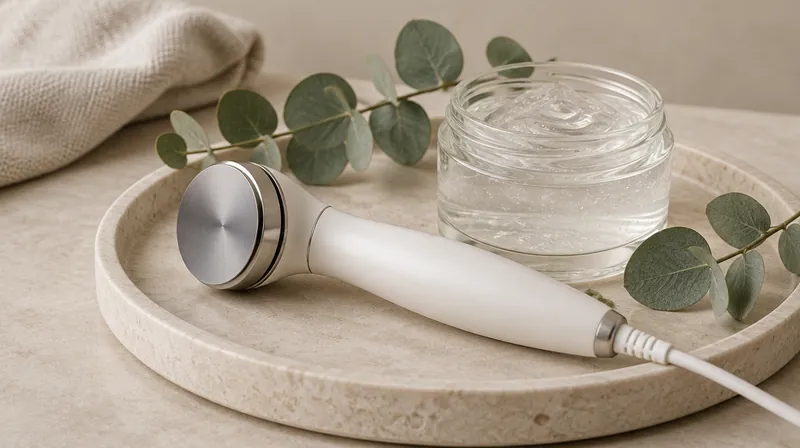
Ultrasound (non-focused, at home)
Disclosure: GlowLab's publisher, Dalmie LLC, is a US retailer of Quadthera and may earn from sales. Learn more.How it works: A small transducer sends low-intensity sound waves in the megahertz range through a gel layer. Multi-frequency devices switch between frequencies. Higher frequencies act closer to the surface and lower ones go deeper. For example, the Quadthera Titan publishes 1, 3, 10 and 19 MHz, and THOME’s The Glow Signature uses 3 + 10 MHz.
Evidence: Ultrasound can temporarily increase skin permeability, known as sonophoresis, and this is well documented in drug-delivery research (Azagury et al., 2014). That supports the “better absorption” claim in principle. For visible anti-aging results, the evidence is mostly small studies paid for by brands. Quadthera (our publisher, Dalmie LLC, retails Quadthera), for example, cites a 4-week, 20-person evaluation by a Seoul research center. Treat these as early signals.
Where it stands out: It’s the gentlest of the five. There’s no light, no deliberate heat and no muscle contraction, and most people barely feel it. That makes it a logical alternative for people who found microcurrent or EMS uncomfortable, want to avoid heat, or want a device that works with their skincare.
Watch-outs: It isn’t Ultherapy or HIFU, so don’t expect clinic lifting. None of the home ultrasound devices we found is FDA-cleared; popular models are Class I listed. Prices for multi-frequency devices run higher than most microcurrent wands.
Learn more: What is at-home ultrasound skincare? · Best at-home ultrasound devices
Multi-function devices (Medicube and others)
Multi-function wands put several technologies in one handset. Medicube’s AGE-R Booster Pro, one of the most-searched devices in this space, combines what Medicube calls electroporation, microcurrent, EMS, “electric needles,” LED and sonic vibration across four modes. The Booster Pro X2 expands this to seven modes. Medicube’s devices are Class I listed with FDA, like the ultrasound devices above, and the X2 is $249 at Medicube’s US store (October 7, 2026). The trade-off is breadth over depth: each function runs inside a compact, affordable device. Read our Medicube AGE-R Booster Pro review for the full picture and how it compares with ultrasound.
How to choose
- You want the strongest evidence for fine lines: start with a red/near-infrared LED mask, ideally one with an FDA clearance you can look up.
- You want a quick, temporary lift before events: microcurrent.
- Firmness is your main goal and you tolerate warmth: RF.
- You want a “facial workout”: EMS.
- You have sensitive or reactive skin, dislike tingling or heat, or want better absorption of your skincare: non-focused ultrasound.
- You want to try a bit of everything on a budget: a multi-function device such as Medicube’s Booster Pro line.
Whichever you choose, consistency matters more than technology. Every option here works gradually, if at all, and stops working when you stop using it.
Frequently asked questions
Which at-home beauty device technology has the best evidence?
Is ultrasound better than microcurrent?
Can I combine devices?
What’s the best device for sensitive skin?
Where do Medicube devices fit?
Sources
- Home LED/IRED mask for crow’s feet: multicenter randomized double-blind sham-controlled trial. Medicine. 2025 (PMC11835066)
- Glass GE. Photobiomodulation: the clinical applications of low-level light therapy. Aesthet Surg J. 2021
- FDA 510(k) K250966 — CurrentBody Skin LED Light Therapy Mask Series 2
- FDA 510(k) K072260 and K120560 — Carol Cole Company (NuFACE)
- Wirecutter: The Best Microcurrent Face-Tightening Products and Tools
- Austin GK, et al. Radiofrequency for face and neck rejuvenation: a systematic review. Lasers Surg Med. 2022
- Shu X, et al. Home radiofrequency device: randomized split-face trial. Dermatol Ther (Heidelb). 2022
- Kavanagh S, et al. NMES device for facial muscle toning: RCT. J Cosmet Dermatol. 2012
- Azagury A, et al. Ultrasound mediated transdermal drug delivery. Adv Drug Deliv Rev. 2014
- Medicube US store — Booster Pro X2 and Booster Pro product pages
- Quadthera Titan product page (our publisher, Dalmie LLC, retails Quadthera)
- THOME The Glow Signature product page